01 / Independent work by Kush Rishi
Model Regression Forensics
A classification release changes behavior. What does the evidence support?
MRF imports aligned release predictions, checks declared requirements and creates portable reports for inspecting changed cases and repairs. Its completed Banking77 study found no consistent diagnostic advantage over simple baselines.
The question
The maintained application compares saved classification releases, checks declared slice policies and makes changed cases inspectable. The completed research asks a separate question: after a model regresses, which training change should a team inspect or reverse? MRF studies what evidence can support that decision, and when a successful repair still leaves the historical cause uncertain.
It separates localization, restoration and specificity: finding a suspicious change, repairing behavior, and distinguishing that repair from plausible alternatives.
Method and architecture
I implemented the prediction importer, source-integrity checks, policy comparison, supplied-repair assessment and portable HTML report. The research uses third-party Banking77 data and a pinned DistilBERT classifier, not an original pretrained model.
Two constructed Banking77 worlds contain five matched label-swap candidates each. Every candidate changes sixty-six label slots while leaving text and aggregate label counts unchanged. Candidate identifiers are opaque. A pinned DistilBERT classifier is trained across three paired trajectories per world.
- 01Construct candidate changes and paired model releases
- 02Rank candidates without benchmark truth
- 03Finalize rankings, then score against planted truth
The study compares deterministic random ranking, target-label overlap, lexical Jaccard, final-checkpoint Grad-Dot and seven-checkpoint TracIn. Ranking aggregation and truth scoring are separate steps with retained identities and digests.
Experiment history
Earlier shape-task experiments tested task capability, lexical shortcuts and restoration specificity. Some could not learn the clean task; others produced nonlocal regressions or competing repairs. They are retained as negative development evidence.
A Banking77 pilot found separable root restoration, but nuisance changes differed structurally. The matched study addressed that confound without removing a semantic shortcut. Its repeated training trajectories are not independent benchmark worlds.
Completed research results
Label overlap and lexical similarity ranked the planted root first in both matched worlds. Grad-Dot and TracIn ranked it first in one world and last in the other. The random reference ranked it third in each.
The model-based diagnostics added no top-1 benefit in this construction. Known target labels and disjoint candidate pairs made the simple baseline decisive.
The simplest baseline
found both roots.
| Diagnostic | World 00 | World 01 |
|---|---|---|
| Label overlap | 1 | 1 |
| Lexical similarity | 1 | 1 |
| Grad-Dot | 1 | 5 |
| TracIn | 1 | 5 |
| Random reference | 3 | 3 |
Known target labels and disjoint candidate pairs expose a shortcut. Repeated training trajectories are not additional benchmark worlds.
Negative results
Matching the size and structure of changes did not make the benchmark semantically difficult. This study cannot establish general root-cause identification or superiority to modern training-data attribution.
A separate deterministic repair example shows another limit: restoring input feature order and reversing model weights both recover the same baseline predictions. The assessment returns ambiguous_repairs and leaves the historical cause not_identified.
Release investigation software
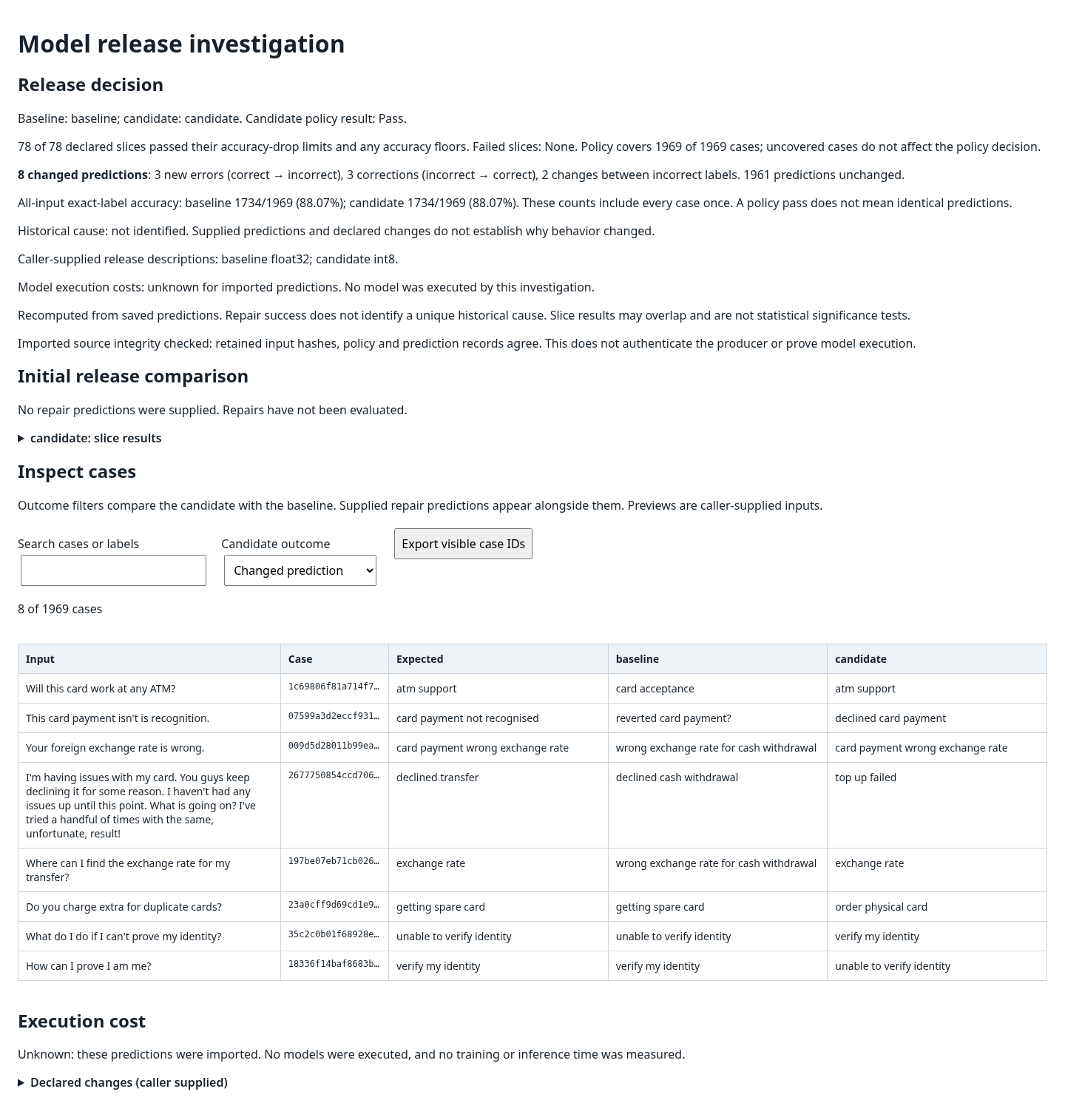
The installed importer accepts aligned baseline, candidate and repair predictions. It checks declared accuracy floors and allowed drops, retains source identities and creates a portable HTML report with text previews, filters and case export.
A retained real-text deployment example contains 1,969 cases. INT8 conversion changes eight labels, including three new errors and three corrections, while overall accuracy remains 88.07% and all declared limits pass. Ordinary prediction comparison reaches the same conclusions. Repairs are unevaluated in this example; no training is needed.
python -m pip install .
mrf-import examples/deployment_comparison/policy.json examples/deployment_comparison/predictions.csv deployment-investigation
Saved-prediction walkthrough · Independent comparison fixture
Limitations
Two constructed worlds, a controlled classifier task and planted changes are a narrow basis for inference. A successful counterfactual repair is not necessarily proof of a unique historical cause. The bounded release utility is in maintenance; the project has no published paper.
Reproducibility
uv sync --extra dev
uv run ruff check .
uv run ruff format --check .
uv run pytest
Python 3.12 or later is required. The retained twelve-file M4 replay reproduces aggregation and truth scoring without a GPU, model training or dataset downloads. It does not regenerate the original scores or checkpoints.
Next evaluation
Observe an independent engineer importing saved predictions, inspecting failed requirements and exporting evidence for a release decision. Fix actual setup or interpretation problems before expanding the application. Maintainer-assisted use does not establish independent user benefit.
A comparative study needs qualified real incidents with known versions and outcome evidence. Compare direct prediction inspection, diff inspection, complete and targeted rollback, and full retraining with matched information and cost. No eligible training-release incident has yet been established; the failed small-model study remains closed.