04 / Independent work by Kush Rishi
PrairieReach
A medical visit is booked. Who handles the ride, paperwork and changes?
A booking changes.
What needs review?
- Outward rideReview required
- Return rideReview required
- Unchanged resourceRetained
Affected tasks are reopened. Reviewing an instruction does not confirm a ride. No messages or appointments are created.
The problem
A booked visit can still depend on a ride, a return journey, paperwork and a support person. A changed booking may leave an old arrangement looking confirmed. PrairieReach tests whether a source-linked plan makes those dependencies easier to manage.
This is a product hypothesis, evolved from CareBridge. The current interface uses fictional journeys. No organization has commissioned it and no patient or customer benefit has been established.
Visual workflow
- 01Record the source instruction and task owner
- 02Confirm arrangements against that source version
- 03Reopen affected tasks when the source changes
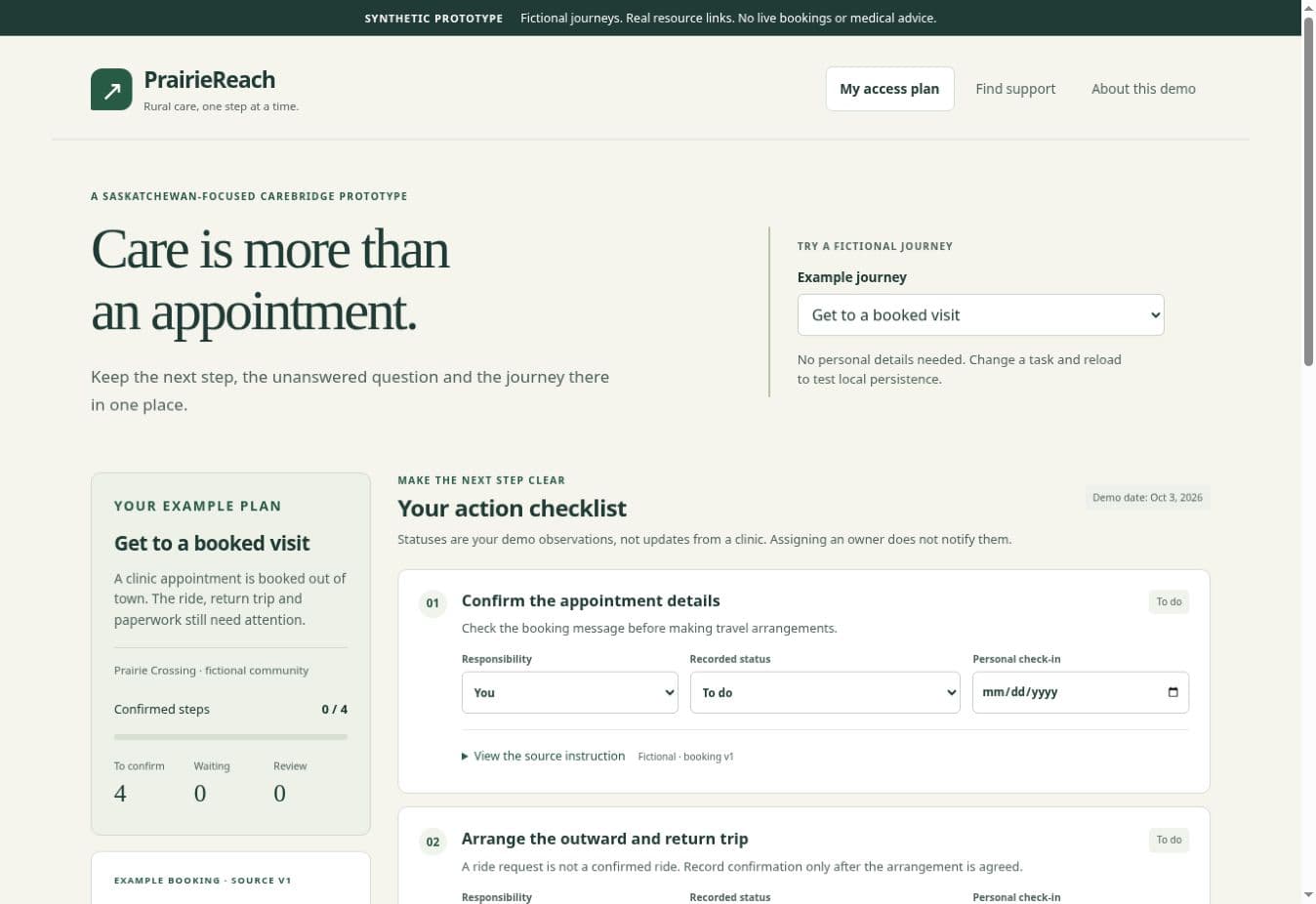
Choose “Get to a booked visit,” confirm the outward and return trip, then simulate a changed booking. Affected tasks require review. Reviewing an instruction does not reconfirm a ride.
Engineering architecture
Pure task transitions connect confirmations to a source version. Responsibility, waiting and confirmed states remain distinct. A bounded local event record can be replayed with schema validation; corrupted storage and write failures are surfaced.
The prototype supports personal check-ins, exports and a small manually reviewed resource set. Responsibility labels are not authenticated delegation. Local browser storage is not a secure patient record or cloud collaboration system.
Existing services
211 Saskatchewan already provides service navigation. Hope Air and Canadian Cancer Society programs address travel and financial support within their conditions. Momentm NovusMED already supplies transport scheduling, dispatch and communication tools. Caring Village already offers shared care calendars, tasks and family coordination; Guava connects personal health records and visit preparation.
The opportunity to test is coordination around several existing services, especially when instructions change. A patient-navigation or community-support team is a possible customer, not a validated buyer. The project should improve a demonstrated workflow rather than assume the market is empty.
What is established
The fictional workflow and its state rules are implemented. Automated tests cover changed-source invalidation, separate review, persistence, storage failures, check-in suppression, exports and resource filtering. Browser checks cover narrow layouts, keyboard entry, downloads and print.
No real-user study, willingness-to-pay test, health-outcome improvement or operational pilot has been completed. A software test passing does not validate the product idea.
Limitations
There are no live appointments, availability data, dispatch, user accounts, notifications, clinic integrations, real-data AI calls or cross-device collaboration. The prototype does not determine urgency, treatment, eligibility or service availability.
Real records require a partner-defined workflow, privacy and security work. A First Nations-specific deployment additionally needs a willing community partner and appropriate community-defined information governance.
Run the prototype
npm ci
npm test
npm run build
npm run dev
The base path stays /carebridge-canada/. The historical CareBridge implementation remains separately documented and is not the current app.
Validation and future work
Compare the same fictional booking-change task against a shared checklist/calendar. Observe correct next-action and owner identification, missed dependencies, false confirmation, task time and support-person effort. Counterbalance order and keep individual failures.
Start with exploratory feedback from approximately five to eight residents or caregivers and two to three administrative reviewers. No outreach has been performed. Proceed only after finding recurring coordination work, a responsible maintainer and a useful improvement over existing tools.
If supported, build record-level access controls, explicit delegation and revocation, durable versioned events and idempotent reminders. Source extraction can later propose tasks for human review. It should not silently book services or make clinical decisions.